
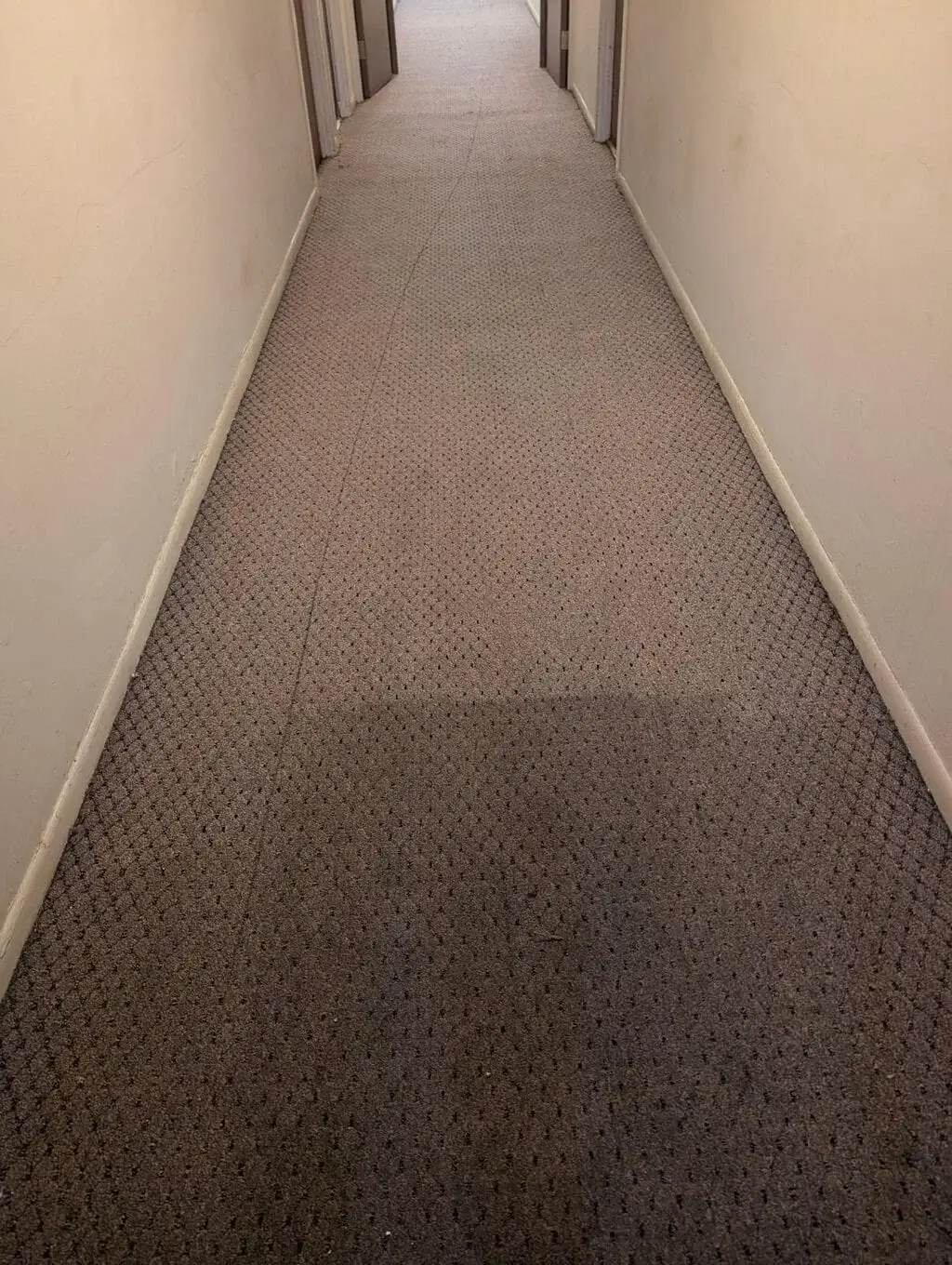
Why Your Carpet Has Black Lines Along the Baseboards
You vacuum every week. The middle of the room looks fine. But there’s a dark gray line along the baseboards that won’t go away.
It often shows up under bedroom doors and along the edges of the stairs, too. It isn’t from a spill, and it isn’t from shoes.
Those black lines on carpet have a name: filtration soiling. Here’s what causes them, why older Chicago homes get it, and what a cleaning can and can’t do about it.
What Filtration Lines Are
The Carpet and Rug Institute describes filtration soiling as dark, grayish lines on carpet. They form where air flows over the carpet or through tiny gaps under it. The air carries fine dust. As it squeezes through, the carpet works like a filter and catches the dust.
CRI says it isn’t a carpet defect, and it happens no matter how much the carpet cost. It shows up more on light colors. The lines can form fast or build slowly over months or years.
Where You’ll See Them
- Along the baseboards, right where the carpet meets the wall.
- Under doors that stay closed, like a guest room or an office.
- Along the edges of carpeted stairs.
- Sometimes in a straight line across a room, where subfloor panels meet.
Closed doors make it worse. CRI suggests leaving interior doors open while the furnace or the AC runs.
Why Older Chicago Homes Get Them
Air moves toward gaps. In many homes, the biggest gap is the thin space under the baseboard.
A lot of older frame houses here use balloon framing. The Encyclopedia of Chicago credits that method with helping drive the city’s building boom in the 1800s. In these walls, the stud spaces can run open from the basement to the attic. A historic home inspector notes that air moves through those open spaces. Some of it gets pulled from under your baseboards.
Heating season adds to it. In rentals, the city’s heat ordinance requires heat from September 15 to June 1. That’s a long season of warm air moving through the walls.
Can Cleaning Remove Them?
Sometimes. It depends on how long the lines have been building, the carpet color, and the fiber.
Lines under doors are usually easier. They’re short and easy to reach. Lines along the baseboards are harder. The dust sits tight against the wall, where it’s tough to scrub without scuffing paint.
Some lines lighten a lot. Others only fade, especially on light carpet that’s had them for years. We’ll point them out at the start and tell you what we expect before we begin. That way the result isn’t a surprise.
Homeowners often think a line that didn’t come out means the cleaner skipped the edges. Usually it means the dust worked deep into the fibers over a long time.
How to Slow Them Down
- Keep interior doors open when the heat or the AC is running.
- Change your furnace filter on schedule.
- Vacuum the edges with a crevice tool. A regular vacuum head can’t reach the line.
- Seal gaps under the baseboards and at the stair edges. CRI notes that sealing these cracks may reduce the problem.
- In an older frame house, ask a contractor about the open wall spaces. The same inspector notes that stuffing insulation into the bottom of open stud bays can cut air movement.
Sealing gaps won’t remove old lines. It does keep new ones from forming as fast.
Lines, Stains, or Wicking?
Not every dark mark is filtration soiling. If a spot came back a day or two after cleaning, that’s usually wicking. Our post on stains coming back after cleaning explains that one. If a spot returns within 48 hours of our visit, call us and we’ll come back to treat it.
A spill that set in is a different job. That’s carpet stain removal.
What a Cleaning Costs
We price by area, not by the room. A room up to 150 sq. ft. is $60, and a hallway up to 75 sq. ft. is $30. A staircase up to 16 stairs is $60. Our service minimum is $180, and spot treatment is included. Cards carry a 3.7% fee.
Our steam carpet cleaning uses hot water extraction. Most carpet is dry in 4 to 6 hours. We work all over the north side, including North Center and Lakeview.
Black Lines on Carpet: FAQ
Are the black lines along my baseboards mold?
Usually not. Dark lines along baseboards and under doors are most often filtration soiling, which is fine dust caught as air passes through the carpet. If the carpet smells musty or feels damp, that’s a different problem.
Will the lines come back after cleaning?
They can, because the air flow that caused them is still there. Sealing gaps under the baseboards slows them down.
Is it a defect in my carpet?
No. The Carpet and Rug Institute says filtration soiling isn’t a carpet defect. It can happen on any carpet, at any price.
Do you clean carpeted stairs?
Yes. A staircase up to 16 stairs is $60, or $5 per stair.
When are you open?
Monday to Friday from 8 AM to 8 PM and Saturday from 8 AM to 5 PM. We’re closed Sunday.
Got Lines You Can’t Vacuum Out?
Call (773) 570-4224 and describe the lines: where they are and how long they’ve been there. The estimate is free, and we’ll tell you what to expect.